




Feb 16 2026 |
The Minor Injury Guideline in Ontario: What It Is, How Insurers Misuse It, and How to Fight Back
One of the most consequential decisions an insurer makes after an Ontario motor vehicle accident is whether to place your injury claim within the Minor Injury Guideline. If they succeed, your medical and rehabilitation benefits are capped at a level that is frequently inadequate to fund the treatment a genuine recovery requires.
The Minor Injury Guideline is not a neutral administrative category. It is a cost-containment tool, and insurers apply it aggressively. In many cases, claims are placed within the MIG despite clinical evidence that the injured person’s condition clearly warrants more support. Knowing what the MIG is, how it works, and what moves a claim out of it is essential knowledge for any person navigating an Ontario accident benefits claim.
For a full overview of how accident benefits work in Ontario, visit the personal injury law page at zaylaw.com. If your insurer has also scheduled an independent medical examination in connection with your claim, see Zayouna Law Firm’s companion article on what to expect from an IME in Ontario.
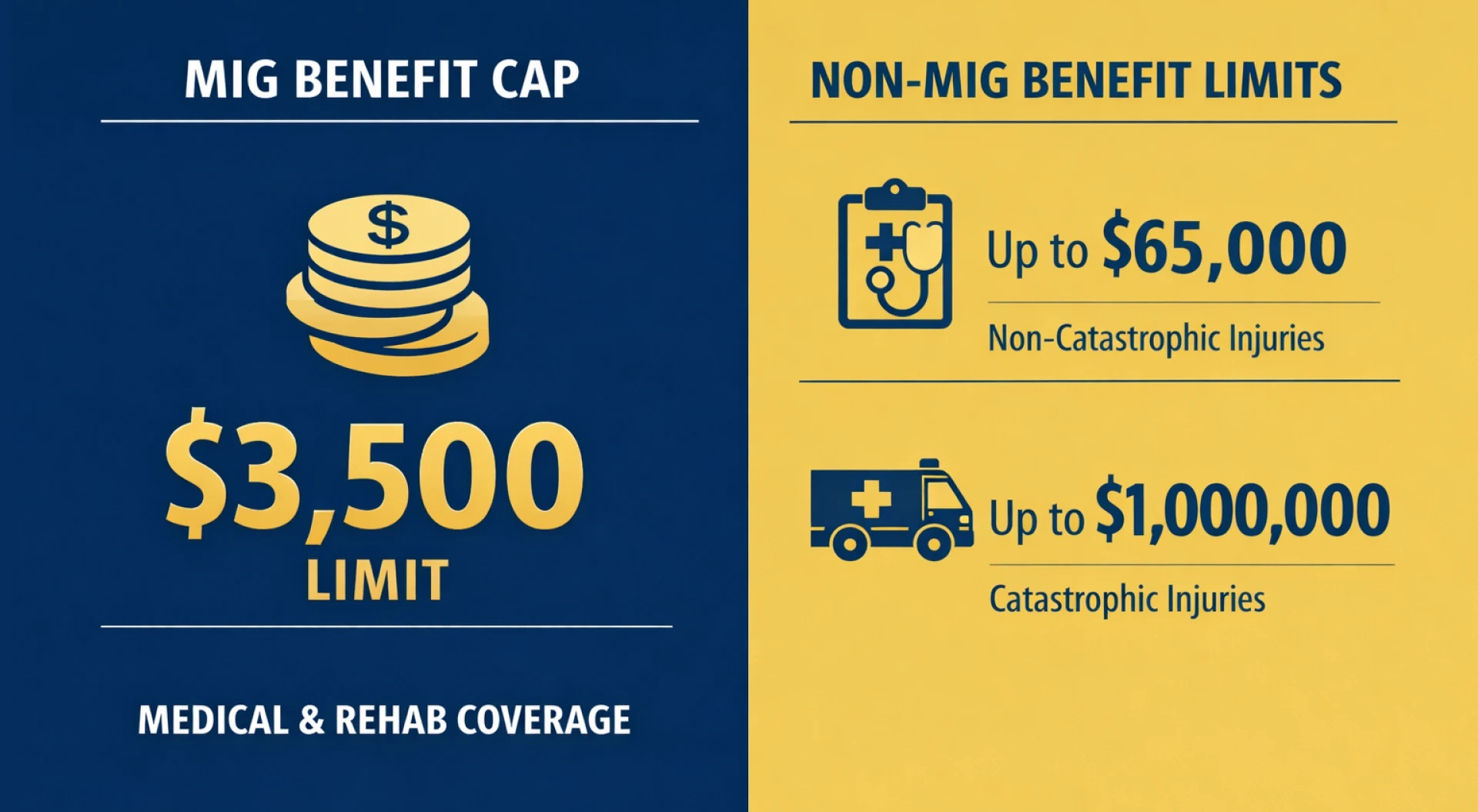
The Minor Injury Guideline is a regulation under Ontario’s Insurance Act that limits medical and rehabilitation benefits for injuries classified as sprains, strains, whiplash-associated disorders, contusions, abrasions, lacerations, or subluxations, where those injuries occur without complication. The maximum combined medical and rehabilitation benefit for MIG-classified injuries is $3,500, with limited additional access for psychological treatment in defined circumstances.
This article covers:
- What the MIG actually covers: The regulatory definition and its intended scope
- How insurers misapply the MIG: The patterns most frequently challenged before the LAT
- Psychological injuries and the MIG: A critical and frequently misunderstood category
- What evidence moves a claim out of the MIG: The clinical and legal threshold
- Your strategic options: What to do when you have been unfairly placed in the MIG
Quick Facts: The Minor Injury Guideline in Ontario
| Key MIG Fact | What It Means for Your Claim |
| MIG benefit cap | Medical and rehabilitation benefits are capped at $3,500 in total; up to $1,500 may additionally be available for psychological treatment services in limited circumstances |
| Injuries covered by the MIG | Sprains, strains, whiplash-associated disorders (WAD) Grades I and II, contusions, abrasions, lacerations, and subluxations, all without complication |
| Injuries that remove a claim from the MIG | A pre-existing condition aggravated by the accident; a diagnosable psychological injury; any injury producing neurological signs or serious impairment; catastrophic impairment designation |
| Who makes the initial MIG determination | The insurer; the claimant can challenge it at the Licence Appeal Tribunal (LAT) |
| Burden of proof to exit the MIG | The claimant bears the burden of establishing on a balance of probabilities that the injury falls outside the MIG definition; medical and psychological evidence from treating practitioners is the primary means |
| LAT jurisdiction | Since 2016, disputes about accident benefits including MIG classifications are heard by the Licence Appeal Tribunal, not by the courts |
What Does the Minor Injury Guideline Actually Cover and What Does It Exclude?
The MIG Definition: Narrow by Design
The MIG applies to a specific and defined list of injury types: sprains, strains, whiplash-associated disorders (WAD) at Grades I and II, contusions, abrasions, lacerations, and subluxations. These injuries are classified as minor because they are, in the absence of complicating factors, expected to resolve with a standard course of treatment within a defined timeframe.
The critical phrase in the MIG definition is ‘without complication.’ An injury that falls within the listed categories but involves complicating factors does not belong in the MIG. Complicating factors that the LAT and courts have recognised include chronic pain that persists beyond expected recovery timelines, diagnosable psychological conditions, pre-existing conditions aggravated by the accident, and concurrent diagnoses that affect recovery.
WAD Classifications and Why They Matter
Whiplash-associated disorder is one of the most commonly disputed MIG classifications. The clinical grading system used in Ontario accident benefits practice classifies WAD injuries as follows:
| WAD Grade | Clinical Description | MIG Status |
| Grade I | Neck complaint of pain, stiffness, or tenderness only; no physical signs | Within MIG (absent complications) |
| Grade II | Neck complaint and musculoskeletal signs including decreased range of motion and point tenderness | Within MIG (absent complications) |
| Grade III | Neck complaint and neurological signs including decreased or absent reflexes, muscle weakness, or sensory deficits | Outside MIG |
| Grade IV | Neck complaint with fracture or dislocation | Outside MIG |
In practice, WAD Grade II with chronic pain, psychological injury, or neurological symptoms is frequently argued to belong outside the MIG even though the grade itself is listed within it. The LAT has held in numerous decisions that a WAD II diagnosis does not automatically confine a claimant to the MIG when the clinical presentation includes complications.
Psychological Injuries and the MIG: A Critical Distinction
One of the most important and frequently litigated aspects of the MIG is its interaction with psychological injuries. The MIG specifically covers a defined list of physical injury types. A psychological injury, including post-traumatic stress disorder (PTSD), major depressive disorder, generalised anxiety disorder, or a diagnosed adjustment disorder with significant functional impact, is not a sprain, strain, or WAD-grade injury.
This means that a claimant who has developed a diagnosable psychological condition as a result of the accident, or whose physical recovery is being impaired by a psychological condition, has a documented basis to challenge MIG placement. The clinical requirement is a formal diagnosis from a regulated professional such as a psychologist or psychiatrist, supported by objective assessment tools and documented functional limitations.
Insurers routinely dispute psychological injury evidence in MIG challenges, often relying on IME reports from assessors who conclude that the claimant’s symptoms do not meet diagnostic criteria. This is precisely the type of dispute that benefits from experienced legal representation. The car accident lawyers at Zayouna Law Firm (zaylaw.com/car-accidents) are well-versed in building the evidentiary record needed for a successful MIG challenge.
How Do Insurers Misapply the Minor Injury Guideline?
The Most Common Forms of MIG Misuse Seen at the LAT
- Placing claims in the MIG based solely on the initial accident report or emergency room notes, without considering the full clinical picture that develops over the weeks and months following the accident
- Ignoring documented pre-existing conditions that are worsened by the accident; the MIG specifically excludes claims where a pre-existing condition is a factor in the claimant’s inability to recover within the expected MIG timeframe
- Dismissing psychological injury evidence as insufficient when the claimant has not yet received a formal diagnosis, despite presenting with clinically significant symptoms documented by treating practitioners
- Relying on an insurer-funded IME to support MIG classification when the treating practitioners’ records clearly document a more complex clinical picture
- Applying the MIG to injuries that include objective neurological findings such as radiculopathy, nerve compression, or documented cognitive changes, all of which are inconsistent with a straightforward soft-tissue injury
- Failing to consider the interaction between multiple injuries sustained in the same accident; a person with both a WAD II injury and a concussion, for example, is not a straightforward MIG candidate
What Evidence Moves a Claim Out of the MIG?
Successfully challenging MIG placement requires building a specific evidentiary record. The following categories of evidence are most effective:
- Treating physician records documenting persistent symptoms beyond expected recovery timelines for a straightforward soft-tissue injury
- Psychological or neuropsychological assessment from a regulated professional documenting a diagnosable condition with functional consequences
- Pre-accident medical records documenting a relevant pre-existing condition, combined with evidence establishing that the accident aggravated it
- Functional capacity evaluation documenting objective limitations in activities of daily living inconsistent with a minor injury
- Specialist reports from physiatrists, orthopaedic surgeons, neurologists, or other specialists documenting objective clinical findings
- Consistent treatment records showing ongoing, clinically directed treatment that would not be necessary if the injury were truly minor
Building this record requires coordination between your legal counsel and your treating team. The personal injury lawyers at Zayouna Law Firm work with clients from early in the claims process to ensure the documentation needed for a successful MIG challenge is being gathered and preserved. Contact us at zaylaw.com/contact-us.
What Are Your Strategic Options When Placed in the MIG?
Option 1: Provide Medical Evidence Directly to the Insurer
The first step is almost always to provide the insurer with clinical documentation supporting your removal from the MIG. This typically means obtaining reports from your treating physicians, psychologists, and other health professionals that specifically address the MIG criteria and document complicating factors. Your lawyer can draft accompanying correspondence formally requesting reconsideration of the MIG determination.
Option 2: File an Application at the Licence Appeal Tribunal
If the insurer maintains the MIG classification despite receiving clinical evidence, the next step is filing an application at the LAT. Once the application is filed, the process moves to a case conference stage at which scheduling, disclosure, and procedural matters are addressed and at which many disputes find resolution or a path toward it. Your lawyer prepares and manages this stage strategically, ensuring the file is positioned for the strongest possible outcome.
Option 3: Proceed to a LAT Adjudication Hearing
If the case conference does not resolve the dispute, the matter proceeds to a formal adjudication hearing before a LAT adjudicator. Medical evidence is filed, witnesses may be called, and insurer-retained assessors may be cross-examined. The adjudicator issues a binding written decision. Zayouna Law Firm’s personal injury lawyers have significant LAT hearing experience and are prepared to advance MIG challenges through the full process where necessary.
Frequently Asked Questions

The MIG cap for medical and rehabilitation benefits is $3,500. Up to $1,500 may additionally be available for psychological treatment in limited circumstances. Claimants whose injuries fall outside the MIG have access to significantly higher limits: up to $65,000 for standard non-catastrophic claims and up to $1,000,000 for catastrophic impairment designations.
Yes, in many cases. A diagnosable psychological condition resulting from the accident, such as post-traumatic stress disorder, major depressive disorder, or a clinically significant anxiety disorder, is not a MIG-category injury. If you have received a formal psychological diagnosis from a regulated health professional supported by objective assessment data, you have grounds to challenge MIG placement. Speak with a personal injury lawyer to assess the strength of your evidence.
From the date of application, the matter moves through a case conference stage before proceeding to a hearing if not resolved. Total resolution time from application to hearing decision can range from 6 to 18 months depending on complexity and scheduling.
You are not legally required to have a lawyer to challenge MIG placement at the LAT. However, MIG disputes require a specific evidentiary record, procedural knowledge of LAT processes, and the ability to effectively cross-examine insurer-retained assessors. Claimants represented by experienced personal injury counsel consistently achieve better outcomes. Zayouna Law Firm offers free initial consultations and represents personal injury clients on contingency.
A treating physician’s opinion that your injuries are more serious than the MIG classification reflects is important evidence. However, the clinical documentation must specifically address the criteria that remove a claim from the MIG. Your lawyer can review your existing records and advise on whether additional assessments are needed to support a challenge. Contact Zayouna Law Firm at zaylaw.com/contact-us for a free consultation.
If your insurer has placed your claim in the Minor Injury Guideline and you believe your injuries are more serious, Zayouna Law Firm offers free consultations for injured Ontarians. We represent personal injury clients on contingency.



Leave A Reply